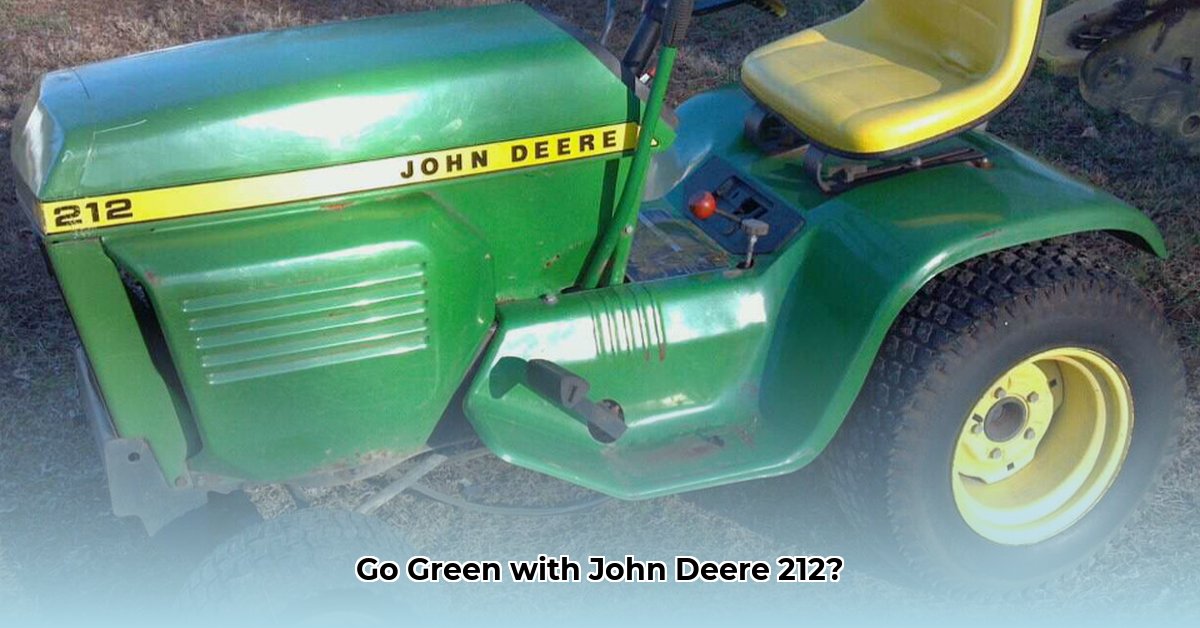
The John Deere 212 lawn tractor, a seemingly ordinary piece of farm equipment from the 1970s and 80s, offers a compelling case study in sustainable agriculture. Its unexpected relevance today stems not from cutting-edge technology, but from its remarkably simple, durable design and surprising ease of repair. This guide explores the John Deere 212's history, technical specifications, maintenance, and, crucially, its unexpected contribution to environmentally conscious farming practices. For comparison, see data on the John Deere 650.
A Blast from the Past: The John Deere 212's History
Manufactured between 1975 and 1987 in Horicon, Wisconsin, the John Deere 212 represents a simpler era of agricultural machinery. Before the complexities of modern electronics dominated farm technology, this tractor prioritized robust build quality and straightforward mechanics. This simplicity is its greatest strength, especially in the context of contemporary sustainability initiatives. Its design, while basic by today's standards, translates to easier repairs and a potentially much longer lifespan, directly countering the "throw-away" culture prevalent in modern consumerism.
Under the Hood: Specifications and Performance
The John Deere 212's heart is a Kohler K301AQS engine, a reliable 12-horsepower workhorse. This air-cooled, 476cc engine provided ample power for a range of tasks, from mowing to snow clearing (with appropriate attachments). While its fuel efficiency compared to modern tractors requires further research, its modest power demands minimized unnecessary fuel consumption for its typical applications. It's a testament to the design philosophy focusing on efficiency and practicality that reduces environmental impact.
Here's a summary of its key specifications:
| Specification | Value |
|---|---|
| Manufacturer | John Deere |
| Production Years | 1975-1987 |
| Engine | Kohler K301AQS |
| Horsepower | Approximately 12 HP |
| Engine Displacement | 476 cc |
Keeping it Running: Maintenance and Repair
One of the John Deere 212's most attractive features is its ease of maintenance. Unlike modern tractors laden with complex electronics, this machine was engineered for durability and straightforward repairs. Regular maintenance—oil changes, lubrication, air filter replacements, and blade sharpening—significantly extends its lifespan. This reduces material waste and the carbon footprint associated with constant replacements.
Actionable Maintenance Steps:
- Regular Oil Changes (Every 50 hours): Use the recommended oil type. This preserves engine health.
- Lubrication (Monthly): Keep moving parts well-lubricated to minimize wear.
- Air Filter Check (Every 25 hours): A clean air filter ensures efficient engine performance.
- Spark Plug Inspection (Annually): Replace as needed for reliable starting.
- Blade Sharpening (As needed): Sharp blades make for cleaner cuts and prevent lawn damage.
While sourcing parts might require more effort than for newer models, the relatively simple design and readily available resources make repairs manageable for many DIY enthusiasts.
Sustainability in Action: The Environmental Impact
The John Deere 212's sustainability stems from its design philosophy. The simpler mechanics mean fewer components are likely to fail, reducing the need for replacements, thus decreasing waste. Repairing an existing machine is inherently more environmentally friendly than manufacturing a new one, aligning with the growing "repair, don't replace" movement. While precise lifetime carbon footprint calculations require detailed fuel consumption data, its inherent durability and repairability significantly reduce its environmental impact compared to many modern machines with shorter lifespans and more complex, less repairable components.
The Bigger Picture: Modern Comparisons and Future Considerations
Comparing the John Deere 212 to modern tractors reveals a crucial aspect of sustainable agricultural technology. Modern tractors often boast increased fuel efficiency thanks to technological advancements, but do these advancements compensate for their higher upfront costs, shorter lifespans, and more complex repair needs? Further research comparing the entire lifecycle—from manufacturing and operation to eventual disposal—of both the 212 and modern tractors is necessary for a complete understanding. The John Deere 212 serves as a valuable reminder that sustainable practices can be found in simplicity and durability, not just in high-tech solutions. The model compels us to consider the long-term implications of our choices in agricultural technology.